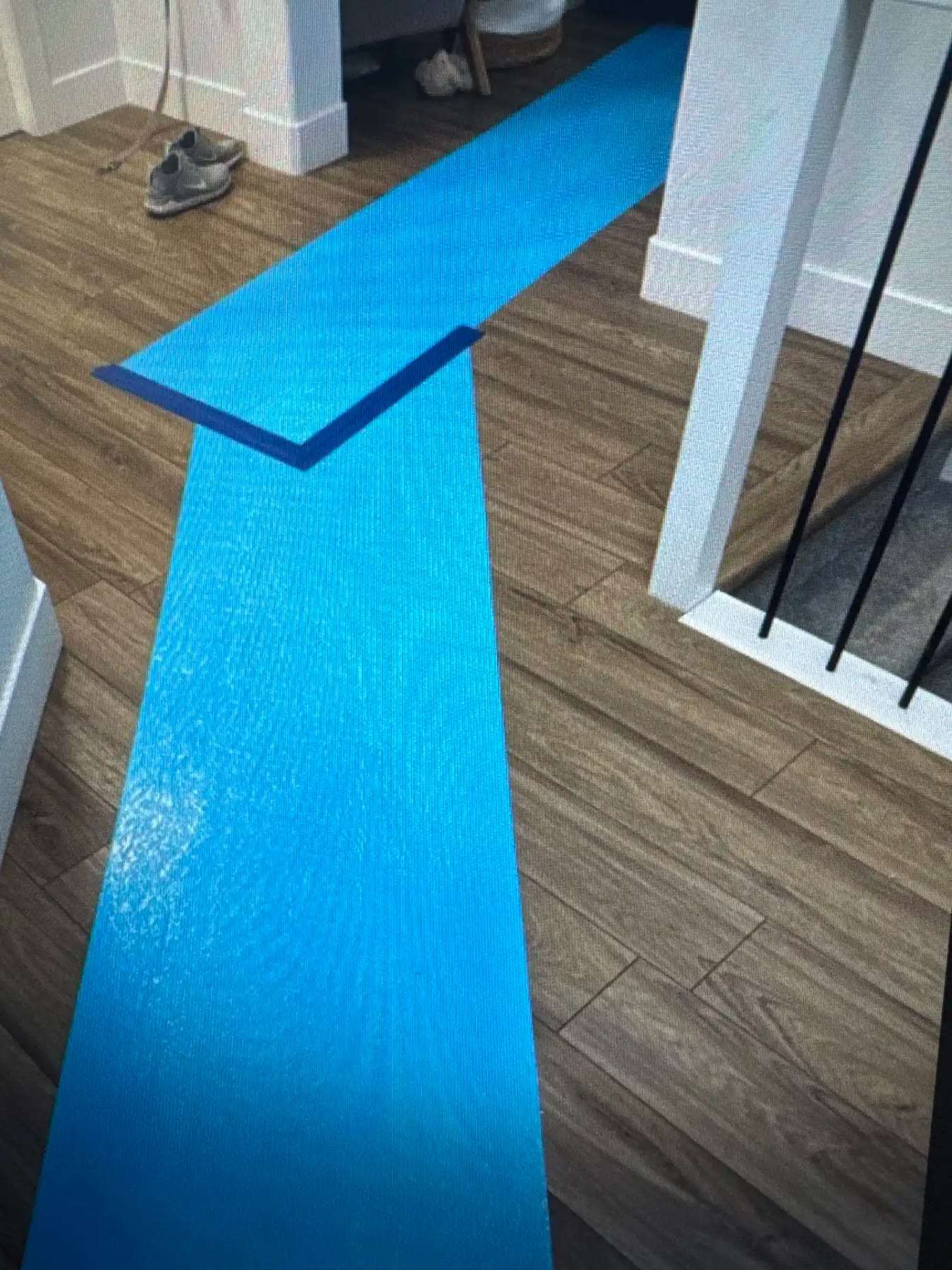
Protective runner laid across tile flooring between rooms. Illustrative image of the process; it does not document a job done for this site.
How to use the map
Print or sketch the floor plan and mark the main source points described below. Then walk the house with the system off and a window cracked, noting each room's smell as faint, clear or strong. The pattern of strength usually reveals where a smell enters and which direction air carries it.
Because production plans reuse layouts, the same pathways appear in many houses: the garage door into the mudroom, the stairwell that connects the basement to the second floor, the return grille that sits in a hallway and the bonus room over the garage. Smells use those pathways. Your job is to find the first room where the smell is strongest, not the last.
After the walk-through, compare the sketch to the table above. A pattern that matches one row, such as strongest smell at the garage door, tells you which zone to test further. A pattern that does not match any row, such as the same smell in every room, suggests looking at the air handler or a house-wide cause.
Zone, typical source and test
| Zone | Typical source points | Simple test |
|---|---|---|
| Garage and mudroom | Stored products, vehicle exhaust, shared wall gaps | Smell at the door with the garage door closed, then open |
| Great room and kitchen | Drains, appliances, fireplace, cooking residue | Compare smell near each, with fan off |
| Stairwell | Carries smoke, basement air and cooking smell upward | Smell at the bottom and the top with doors open |
| Basement | Capped plumbing, pit lids, damp slab, storage | Smell with the furnace off, then on |
| Bonus room above garage | Garage air through floor gaps and ductwork | Check outlets and the floor edge near the garage side |
| Bedrooms and closets | Soft goods and old residue | Smell inside the closet with the door shut for an hour |
Mark these on your sketch
- Every return grille and supply register on each level.
- The location of the water heater, furnace and any sump or ejector pit.
- Doors between the garage and living space and whether they seal.
- Fireplaces and their chimney chases.
- The room where the smell is strongest and the direction air moves from there.
Common questions
Do I need professional equipment for this?
No. A calm walk-through, a sketch and a notebook give most of the value. Specialists can then target their testing.
Can I use this for a house that is not a production plan?
Yes. The method works anywhere, though the typical sources will differ.
General information for Highlands Ranch, not a quote or professional advice. In an emergency, call 911.